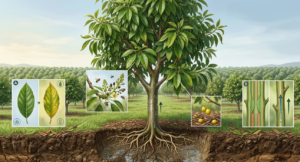
At Fruty Green, we know that every detail counts when it comes to obtaining the highest quality Hass avocados. Among the most crucial aspects of agronomic management is avocado training pruning, a practice that defines the tree's structure, facilitates fieldwork, and ensures abundant and sustainable production.
If done correctly during the first few years, formative pruning helps strengthen the trunk, distribute the foliage evenly, and improve light penetration and ventilation for the tree. All of this results in more uniform, healthier fruit with greater commercial value.
What is avocado training pruning and why is it important?
Avocado training pruning is a technique applied in the early years of the tree's life, generally between the first and fourth year. Its main objective is to shape the tree's structure so that it grows into a solid, balanced form capable of supporting the weight of future production.
Furthermore, maintaining a well-distributed and open canopy improves light penetration and airflow, reducing the occurrence of fungal diseases and optimizing photosynthesis. In the case of Hass avocados, this pruning is essential, as their natural growth tends to be unruly if not guided from early stages.
Among the most notable benefits of this practice are:
- Greater structural stability of the tree.
- Ease of handling and harvesting.
- Increased productivity and fruit quality.
- Reduction of the risk of diseases and pests.
How to properly perform formative pruning of an avocado tree?
Properly executed avocado tree pruning requires planning and precision. Below, we explain the step-by-step process to achieve an ideal structure:
1. Selection of the main branches
The first step is to choose the branches that will form the base of the tree. Ideally, you should leave three to four main branches, evenly distributed around the trunk. This allows for a balanced crown and better distribution of the fruit's weight.
2. Determine the height of the trunk
Define the height of the point where the main branches begin, known as the "tree's crown." Generally, a height of 60 to 80 centimeters from the ground is recommended, which promotes stable growth and facilitates pruning and harvesting.
3. Make clean and safe cuts
Use sharp, disinfected tools to avoid tears or infections. Cuts should be made at a 45° angle, which helps prevent water from accumulating and allows the wound to heal properly.
4. Pruning of side branches
Pinching back the side branches encourages the development of secondary shoots, resulting in a denser and more productive crown. This step is essential for giving the tree a balanced and resilient shape.
Want to learn how to do this type of pruning correctly? We invite you to watch this short video: “"How to perform your formative pruning on avocado trees step by step."”
Tools and necessary care
To ensure optimal results, use appropriate tools and make sure to maintain proper hygiene throughout the process:
- Pruning shears and saws well sharpened.
- Protective gloves to avoid injuries.
- Constant disinfection of the tools before and after pruning.
A good practice is to apply healing sealant to the main cuts, preventing the entry of pathogens and accelerating the recovery of the plant tissue.
Post-pruning care
After performing formative pruning of avocado trees, it is important to provide the tree with the necessary conditions for proper recovery.
- Balanced irrigation: Maintain constant moisture without waterlogging the soil.
- Supplementary fertilization: Apply fertilizers rich in nitrogen, calcium and boron to strengthen the growth of new shoots.
- Pest and disease monitoring: Observe the overall condition of the tree and apply preventative treatments if necessary.
These precautions ensure that the tree does not become stressed and continues to develop vigorously.
Pruning frequency
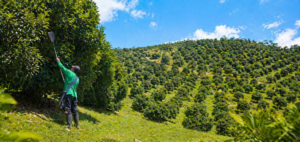
The formative pruning of avocado trees is carried out during the first 3 or 4 years, with light and periodic interventions to gradually shape the tree. From that point on, maintenance and renewal pruning continues to preserve the established structure.
Want to learn more about pruning techniques? We invite you to read our article: “Hass Avocado Pruning: The Secret to a Lumpy and Healthy Harvest.”
Long-term benefits
A well-formed tree not only results in a more attractive crop, but also in a stronger structure, balanced growth, and consistent production. Furthermore, it facilitates access to sunlight, improves ventilation, and reduces the risk of breakage during harvest.
At Fruty Green, we promote avocado training pruning as an essential tool for obtaining healthy, productive and sustainable trees, guaranteeing excellence in every fruit that reaches the consumer.
Educate well today to produce better tomorrow.
Avocado pruning not only shapes the tree, but also the success of the entire crop. A proper structural design results in strong, well-balanced trees, ready for a longer productive life.
Implementing this technique with precision and consistency makes the difference between a crop that merely survives and one that truly thrives. At Fruty Green, we work to support growers at every stage of the process, promoting responsible and effective agricultural practices.