An avocado tree produces oxygen through photosynthesis, but there isn't a single figure that applies to all cases. The amount can vary greatly depending on the tree's age, canopy size, number of active leaves, solar radiation, available water, nutrition, and health.
In general, a healthy, adult avocado tree can produce from tens to several hundred kilograms of oxygen per year, Depending on their conditions. In large trees, with good leaf area and proper management, production can be higher; in young, stressed trees or those with few active leaves, it will be much lower.
Rather than seeking an exact number, the important thing is to understand what factors cause a tree to produce more or less oxygen and how that data relates to the health of the crop.
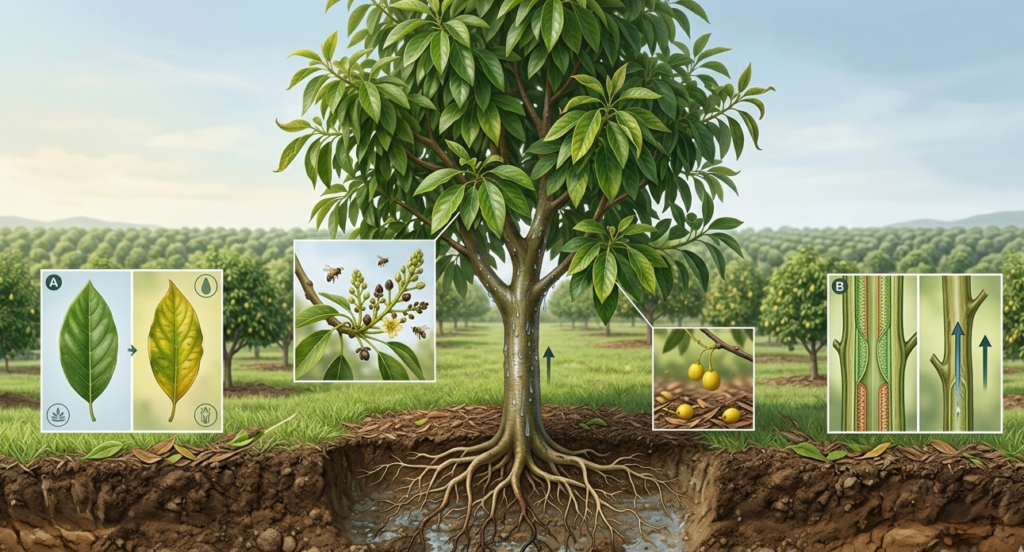
The oxygen released by an avocado tree comes from photosynthesis. During the day, the leaves capture carbon dioxide (CO₂), water, and sunlight to produce sugars. In that process, they release oxygen (O₂).
However, the tree also respires. Respiration occurs day and night, and consumes some of the oxygen produced. Therefore, when discussing how much oxygen an avocado tree produces, it's important to differentiate between:
- Gross oxygen production: all the oxygen released during photosynthesis.
- Net oxygen production: the oxygen that remains after subtracting what the tree consumes when breathing.
This difference is key to avoid inflating figures or making inaccurate statements.
Why does production change between day, night, and seasons?
During the day, photosynthesis increases when there is good light, suitable temperature, and sufficient water. In many avocado-producing areas of Colombia, peak activity typically occurs during periods of high solar radiation, especially in the morning and part of midday.
At night, the tree does not photosynthesize, but it does respire. This means it consumes oxygen. Furthermore, when nighttime temperatures are high, respiration can increase.
During the dry season, if a tree suffers from water scarcity, it partially closes its stomata to prevent moisture loss. This reduces CO₂ uptake and lowers photosynthesis. During the wet season, if there is good soil aeration, adequate nutrition, and overall health, the tree can maintain more stable photosynthetic activity.
Factors that most influence how much oxygen an avocado tree produces
Oxygen production does not depend solely on the size of the tree. A large, but stressed, tree can produce less than a more balanced and well-managed one.
The most important factors are:
- number of active leaves;
- exposure to light;
- water availability;
- nutrition;
- age of the tree;
- health status;
- pruning management;
- soil and root conditions.
Leaf area: more healthy leaves, more photosynthetic capacity
Leaf area is one of the most important factors. Simply put, the more healthy leaves a tree has that are well exposed to light, the greater its capacity to produce oxygen.
A young tree has a small leaf area and, therefore, produces less oxygen. A mature tree, with a balanced canopy and good management, can have a much larger leaf area.
But it's not just about having a lot of leaves. It's also important that those leaves receive light. A canopy that's too dense may have many leaves, but little efficiency, because much of it remains shaded.
Therefore, technical pruning helps to maintain a well-ventilated canopy, with good light penetration and truly active leaves.
→ If you want to delve deeper into this point, consult How to interpret foliar analysis in avocado and improve nutrition
Light and climate: the engine of photosynthesis
Sunlight is the energy source for photosynthesis. On cloudy days or days with low sunlight, oxygen production decreases. On days with good sunlight and moderate temperatures, the tree can function more efficiently.
Avocado trees also respond to extreme heat. When the temperature gets too high, the tree can close its stomata, reduce photosynthesis, and increase its respiration. This affects both oxygen production and fruit development.
Water and nutrients: balance to produce oxygen and fruit
Water is essential for photosynthesis. When it's scarce, the tree reduces its activity to protect itself. When there's too much and the soil becomes waterlogged, the roots lose oxygen, weaken, and nutrient absorption decreases.
Nutrition is also key. Elements such as nitrogen, magnesium, and potassium are involved in chlorophyll formation, leaf function, and the overall balance of the tree.
A well-nourished tree, with adjusted irrigation and healthy roots, will have better photosynthetic capacity and, therefore, greater oxygen production.
Tree age: how much it influences oxygen production
A young avocado tree produces little oxygen because it has fewer leaves and less structure. As it grows, its canopy and photosynthetic capacity increase.
In Hass avocados, the tree's productive capacity typically increases as the canopy develops and its structure improves. However, an old, diseased, or poorly managed tree can lose efficiency.
Age matters, but it doesn't work alone. An adult tree with damaged roots, insufficient light, or nutritional deficiencies can produce less oxygen than a younger, healthy, and well-managed tree.
Stress, pests and diseases: when the tree stops working well
Stress reduces photosynthesis. This can be caused by lack of water, excess water, soil compaction, defoliation, pests, or diseases.
For example, a tree affected by root problems may lose leaves, experience reduced new growth, and decrease its photosynthetic activity. In such cases, carbon sequestration also declines, and fruit production may be affected.
Therefore, improving oxygen production is not an isolated goal. It is a consequence of having healthy, active, and well-managed trees.
→ To better understand this problem, review How to eliminate pests in avocado trees with a prevention and biological control approach.
Realistic estimate: how much oxygen can an avocado tree produce
Accurately calculating how much oxygen an avocado tree produces requires specialized measurements. Even so, useful estimates can be made if the assumptions are clearly explained.
A practical way to estimate it is to consider:
- active leaf area of the tree;
- average rate of photosynthesis;
- effective hours of light;
- active days per year;
- tree respiration;
- stress or management conditions.
| Scenery | Tree condition | Estimated annual O₂ production |
|---|---|---|
| Low |
Sapling, small leaf area or stress |
10–50 kg |
| Half |
mature, healthy tree and with normal handling |
50–150 kg |
| High |
Large, vigorous tree, well lit and without stress |
150–300 kg or more |
With these factors, a prudent estimate might look like this:
These values should be understood as indicative ranges, not as universal figures. In the field, the variation can be significant.
Why it's not advisable to use absolute figures
Saying that “an avocado tree produces X kilos of oxygen per year” may sound appealing, but it is not always correct.
Production changes due to:
- tree size;
- planting density;
- pruning management;
- water availability;
- solar radiation;
- root state;
- level of defoliation;
- age and variety;
- soil conditions.
Therefore, for a technical or sustainability blog, it is more responsible to talk about ranges and explain the factors that modify them.
Oxygen, carbon and fruit: how they are related
Oxygen production is directly linked to carbon capture. When a tree fixes CO₂, it releases O₂ and uses the carbon to form leaves, branches, roots, trunk, and fruit.
However, oxygen and carbon are not the same thing. Carbon capture is measured in biomass or stored carbon, while oxygen production is estimated from photosynthetic activity.
A productive tree allocates some of its carbon to the fruit. Therefore, good management seeks a balance: healthy trees, good production, active roots, and sufficient leaf area to sustain the system.
Other environmental benefits of the avocado tree
In addition to producing oxygen and capturing carbon, a well-managed crop can provide other environmental services:
- improved vegetation cover;
- local temperature reduction;
- soil protection;
- water infiltration;
- habitat for pollinators and beneficial fauna;
- greater stability of the productive landscape.
These benefits depend heavily on management. A crop with covered soil, healthy trees, and good agronomic practices can yield more than a degraded or poorly managed system.
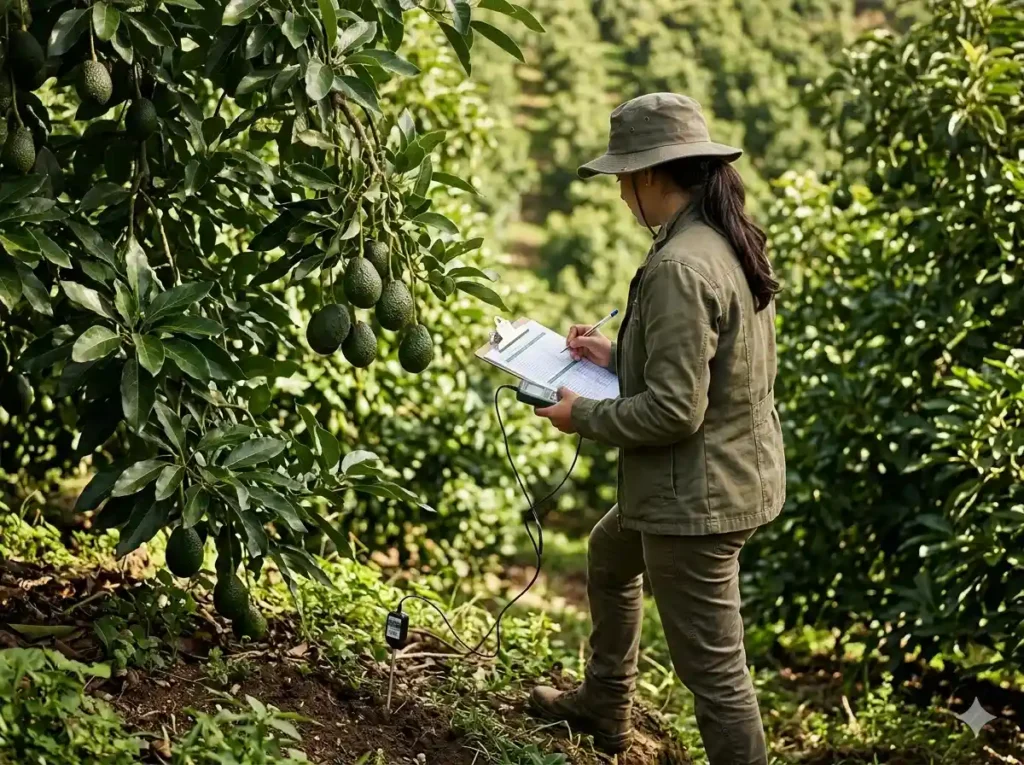
How to better estimate oxygen production on a farm
For a farm or agricultural export company, the most useful thing is not to have a generic figure, but to build your own estimate.
A simple methodology might include:
- select representative trees per block;
- measure or estimate leaf area;
- record light conditions;
- monitor soil moisture;
- assess vigor, health and defoliation;
- cross-referencing data with tree-based performance;
- update the seasonal estimate.
This approach allows for more useful data for internal reporting, sustainability, and decision-making.
Useful indicators for monitoring the tree's condition
Some practical indicators that can help are:
- estimated leaf area per tree;
- chlorophyll index;
- trunk growth;
- percentage of defoliation;
- soil moisture;
- yield per tree;
- root state;
- incidence of pests or diseases.
This data does not directly measure oxygen, but it does help to understand the photosynthetic capacity of the tree.
Simple tools to improve estimates
Complex equipment isn't always necessary. For an operational estimate, tools such as the following can be used:
- soil moisture meters;
- temperature sensors;
- light meters or PAR;
- photographs of the canopy to estimate leaf area;
- pruning records;
- leaf and soil analysis;
- spreadsheets with clear assumptions.
If the objective is a more formal technical or sustainability report, it is ideal to complement these tools with biomass inventories and validated methodologies.
Limitations: why measuring is better than repeating general figures
General figures are useful as a guide, but they don't replace local measurements. Two avocado trees of the same age can have very different yields if one is well-nourished and the other suffers from water stress or root problems.
Furthermore, the data can change between zones, altitudes, seasons, and management systems.
Therefore, if you are going to communicate how much oxygen an avocado tree produces, the most responsible thing to do is to accompany the figure with:
- estimated range;
- assumptions used;
- growing conditions;
- methodology;
- level of uncertainty.
This avoids exaggerated claims and improves the credibility of the content.
Good practices to improve net oxygen production
The same practices that strengthen the tree's health also help improve its photosynthetic capacity:
- adjust irrigation according to soil, climate and crop stage;
- avoid puddles;
- maintain healthy roots;
- fertilize based on soil and foliar analysis;
- perform technical pruning to improve light penetration;
- control pests and diseases before they cause defoliation;
- maintain managed vegetation cover;
- avoid soil compaction.
These actions not only promote oxygen production, but also help improve productivity, fruit quality, and crop stability.
How much oxygen does an avocado tree produce in practice?
An avocado tree does not always produce the same amount of oxygen. The figure can range from low levels in young or stressed trees to much higher values in healthy, well-managed adult trees.
To communicate this information responsibly, it is best to talk about ranges, explain the conditions, and avoid absolute promises.
On a farm, measuring and recording your own data will always be more valuable than repeating general figures. A tree with a good canopy, healthy roots, sufficient water, and proper management not only produces more oxygen but also supports the fruit better, provides environmental services, and strengthens the true sustainability of the crop.
Frequently Asked Questions
How can the actual oxygen production of an avocado tree be measured in the field?
Measuring gas exchange directly requires specialized equipment, which is why it's not usually practical for a commercial farm. The most viable approach is to estimate production based on leaf area, tree condition, light data, soil moisture, and biomass inventories.
For more technical reports, it is recommended to work with validated methodologies and clearly state the assumptions used.
What is the most common mistake when talking about oxygen produced by trees?
The most common mistake is using a general figure as if it applied to all trees. Production varies depending on species, age, size, climate, management, water, nutrition, and health.
It is also common to confuse gross photosynthesis with net oxygen production.
Does an avocado tree produce more oxygen if it bears more fruit?
Not necessarily. The fruit uses some of the carbon that the tree fixes during photosynthesis, but oxygen production depends primarily on leaf activity.
A productive and healthy tree usually has good photosynthesis, but excessive load, stress, or deficiencies can affect both the fruit and the foliar activity.
What tools help to better estimate oxygen production?
For a farm, humidity sensors, temperature logs, light meters, canopy photographs, foliar analysis, and yield data can be useful.
With that information, more realistic estimates can be built by block or by batch.
How can this data be included in sustainability reports?
It is recommended to present ranges, methodology, and assumptions. Avoid absolute statements such as "each tree produces exactly X kilograms of oxygen.".
A more robust way is to show scenarios: conservative, medium and high, accompanied by field evidence such as sampling, irrigation records, foliar analysis or biomass inventories.