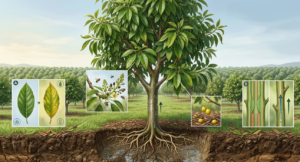
The Hass avocado is one of the crops most sensitive to nutritional imbalances. When a tree does not receive adequate amounts of micronutrients, the fruit often shows visible alterations that affect its commercial quality, post-harvest life, and yield. Among the nutrients whose absence causes the most damage are calcium, boron, and zinc.
In this guide, you will find detailed and verified information to recognize the symptoms of these deficiencies, understand why they occur, and apply corrective measures in time to protect the productivity of your crop.
Effects of calcium deficiency in Hass avocado
Calcium is an essential nutrient for the cell wall formation, The structural integrity of the fruit and its internal firmness are affected. Its mobility within the plant is limited, so any disruption in supply can directly impact the fruit, especially in the early stages of growth.
Symptoms of calcium deficiency in avocado fruit
- Necrotic spots on the skin
The fruit develops dark, sunken, or dry areas that can increase in size. These spots affect the external appearance and reduce the commercial value of the Hass avocado. - Surface cracks or fissures
As the cell walls weaken, the fruit loses elasticity and becomes more prone to splitting. This increases the risk of infection and damage during transport. - Deformities and irregular sizes
A lack of calcium disrupts proper cell development, resulting in asymmetrical, small, or abnormally curved fruits.
How to correct calcium deficiency
- Incorporation of calcium amendments into the soil
Products such as agricultural lime or agricultural gypsum can improve the availability of calcium in the soil profile. - Foliar application of calcium
Rapidly absorbed foliar fertilizers are useful during critical times of fruit development. - Soil pH adjustment
Maintaining a pH between 6 and 7 promotes calcium absorption. Soils that are too acidic hinder the availability of this nutrient. - Proper irrigation management
Irregular irrigation can disrupt the transport of calcium to the fruit. A consistent irrigation schedule promotes its distribution.
Do you know how long it takes for an avocado tree to start bearing fruit? Find out in our article: “How Long Does It Take for a Hass Avocado to Bear Fruit? Everything You Need to Know”.
Impact of boron deficiency on Hass avocado
Boron is essential for cell division, flowering, fruit set, and structural stability of the fruit. Its deficiency is often associated with low mobility in the soil and prolonged periods of drought.
Symptoms of boron deficiency in avocado fruit
- Alterations in the growth of fruit tissue
Fruits may exhibit hardened areas, deformities, or irregular growth due to problems in tissue formation. - Spots and necrosis on young leaves
Although it occurs in the aerial part, this sign is later reflected in a malformed fruit or one with weak tissue. - Increased fragility in branches and fruit
Boron deficiency causes poor lignification, which increases the risk of branch fractures and early fruit drop.
How to correct boron deficiency
- Controlled application of fertilizers containing boron
Common options include borax and boric acid. Their use must be precise, as excess boron can also be toxic. - Improve soil moisture
Boron is primarily transported through water. Even irrigation helps the roots absorb it properly. - Periodic soil and foliar analyses
They allow for the establishment of safe doses and the prevention of both deficiencies and accumulations. - Foliar applications at critical stages
During pre-flowering and fruit set, foliar application of boron improves the initial structure of the fruit.
Want to learn how to identify these deficiencies in your crop? We invite you to watch this short and practical video: “Detect Boron and Zinc Deficiency in Your Crop”.
Consequences of zinc deficiency in Hass avocado
Zinc is involved in protein synthesis, shoot development, and hormonal regulation. It is one of the most frequently deficient micronutrients in agricultural soils, especially in volcanic areas or those with high pH.
Symptoms of zinc deficiency in avocado fruit
- Small, deformed, and chlorotic leaves
Although the first symptoms appear in the foliage, they directly impact the size and uniformity of the fruit due to the tree's reduced photosynthetic capacity. - Production of smaller and less uniform fruit
Zinc deficiency affects auxin synthesis, slowing growth and resulting in smaller fruit size. - Mottled or irregular patterns on leaves
Leaf with interspersed green and chlorotic areas, reflecting a nutritional imbalance that affects the vigor of the tree and the quality of the fruit.
How to correct zinc deficiency
- Application of zinc sulfate or zinc chelates
They are the most effective sources for correcting the deficiency both in soil and in foliar applications. - Foliar sprays during budding
Early application facilitates more efficient distribution to shoots and future fruit. - Improve the organic matter content in the soil
Organic matter facilitates the availability and absorption of zinc, especially in soils with high pH. - Soil pH adjustment
Values above 7 limit zinc availability. Making corrections helps improve its absorption.
Want to learn more about avocados and their components? We invite you to read our article: “What is the avocado seed used for?”.
Correcting deficiencies in time improves the quality of the fruit.
The calcium, boron and zinc deficiencies in avocado fruit These symptoms represent one of the most determining factors in the final quality of Hass avocados. Recognizing the symptoms early allows for preventative action and adjustments to nutritional management, irrigation, soil pH, and foliar applications.
At Fruty Green, we know that balanced nutrition not only guarantees larger, more uniform fruit, but also greater post-harvest resistance and a longer shelf life. Addressing these deficiencies promptly is a direct investment in crop productivity and competitiveness.